

By James Forrester
(First published in Take One Magazine, Summer 1988, reprinted here with permission of the author. All photos courtesy James Forrester)
During the 1950s and 1960s, the word television was synonymous with the CBC and to a minor degree the NFB. Crawley Films received numerous film awards and made hundreds of films, the majority of them shown on television; however, most Canadians have never heard of Crawley Films. You have to ask yourself why?
It may have something to do with our classic Canadian self-deprecation. Frank Randford “Budge” Crawley was born in Canada, established his company here and refused to go to London, New York or Los Angeles to work. Canadians in the 1950s, ’60s and ’70s were always more impressed with filmmakers who spent years working elsewhere and returned with the Hollywood or New York stamp of approval.
While it is true that he received an Oscar, he paid the price for having the chutzpah to sue a major American studio (Universal) for its dumping of the rockumentary Janis onto television rather than distributing it theatrically. During the Capital Cost Allowance era, he criticized government policy that led to so many bombs, thereby antagonizing the film “packagers” who didn’t like anyone rocking their boat. Crawley became the black sheep of the Canadian film industry.
David Clandfield, in Canadian Film, speculates that, “such is the scale, reputation and accessibility of the National Film Board that historians inevitably give less attention to commercial and independent documentaries.” In reality, I think that Canadian film historians have had a fixation with the NFB (and the CBC) because the films produced by these agencies happened to match their own personal ideology. Crawley productions, on the other hand, were somewhat suspect because the business world sponsored the majority of his films. During the 1960s and ’70s, business was vilified by the academic world. It’s hard now to put this into perspective with the current academic community’s lust for corporate funding.
Crawley Films began as a hobby for Budge Crawley, the athletic son of an Ottawa accountant, Arthur A. Crawley. “Budge” became an accountant, joined his father’s firm, but he continued to experiment with filmmaking during the 1930s. With his Kodak Cine-Special, he made a number of black-and-white industrial films, amateur films on canoeing and a 1938 travelogue on Ile d’Orleans made with his wife Judith, on their honeymoon.
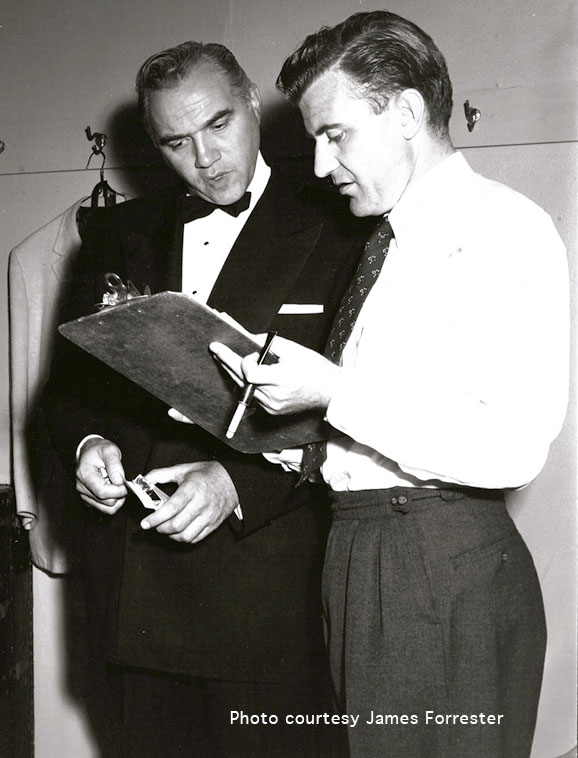
The NFB was founded in 1939, as an advisory body to the Canadian Government. Up until 1941, when the NFB became an active production agency, John Grierson found it convenient to channel contracts to independent companies like Crawley Films rather than deal with the bureaucracy of the Canadian Government Motion Picture Bureau. There was an urgent need for training films, so Budge and Judith took over the top floor of the Crawley family home, turning a billiard room into a film studio. Crawley Films grew to a staff of six during the war, making a wide range of films for the government, but also completing films for industry and cultural groups like the Canadian Geographical Society. During the war years, the Canadian government expanded the outlet for documentary and sponsored films through the formation of nontheatrical circuits. Sponsored films were offered to audiences “free of charge,” by distributors like Modern Talking Pictures, in addition to the NFB. Like the “free lunch” of the 1890s and “free television” of more recent times, there was a catch. Image left: Lorne Greene discusses script with Director Stanley Moore.
The sponsor, whether it be a government department or a large corporation, had a message in the medium. Crawley Films had evolved from a tight-knit group of family and friends into a small business by 1946. The company had outgrown the cramped quarters and an old church hall was purchased. Government contracts diminished and the company had to rely mainly on business and industry for sponsorship.
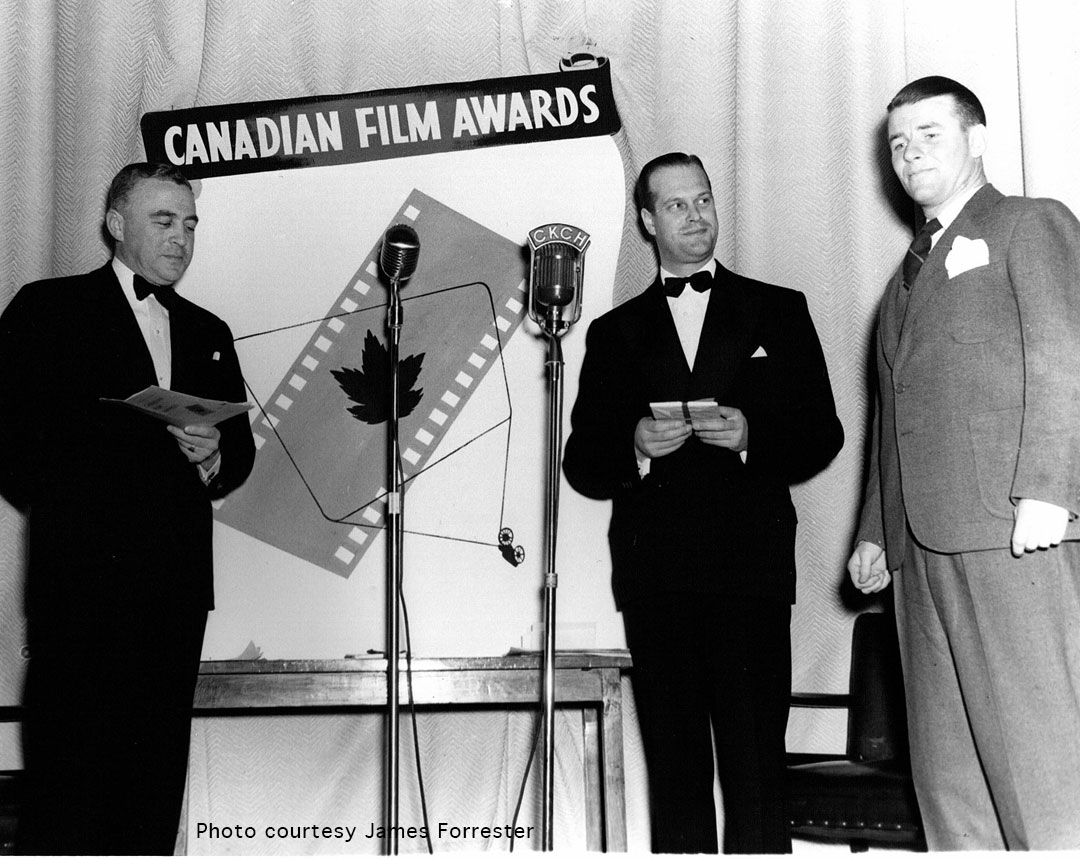
The first Film of the Year Award at the Canadian Film Awards in 1949 went to Crawley Films for the native legend, The Loon’s Necklace. The film was made on speculation and it was only after it won the award that Imperial Oil supported its distribution. It went on to win many international awards and helped establish the reputation of the company. By 1949, Crawley Films had 33 employees. That’s when the company spirit began to change. As the demand increased for films during the 1950s, more experienced film personnel were brought over from Britain. In 1952, Budge won the Film of the Year Award for Newfoundland Scene, which was again sponsored by Imperial Oil. Most of the footage was shot by him with an assist from one of Crawley’s best cameramen, Stanley Brede. The whaling sequence was sold to RKO Radio Pictures and incorporated into The Sea Around Us, which went on to win the Oscar for best documentary in 1953.
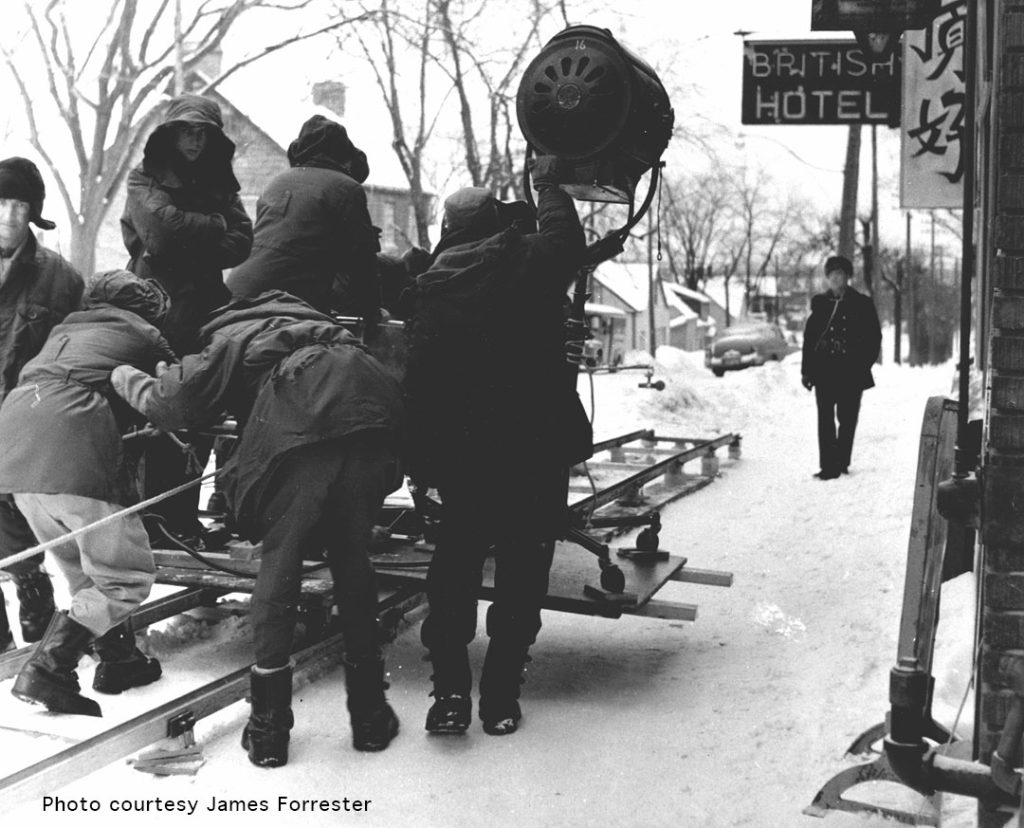
Budge was a cameraman/director on many of the early films made by the company. In time, he was forced to take on the role of producer, as he became more interested in the development of the Canadian television and feature film industry. He was executive producer for The RCMP series (1959), the Au pays de Neuve—France/ St. Lawrence North series (1959) and The Tales of the Wizard of Oz (1962), which was the first Canadian animated series. In 1958, Crawleys began to build a film studio at Old Chelsea in the Gatineaus. The studio was built in preparation for the production of 39 episodes in The RCMP series, cofinanced by Crawley, McConnell Ltd., the CBC and the BBC. At the time, Budge wrote in a promotion, “the decision to pioneer television film production in this country was made on the premise that we can make a place for ourselves in the world television market by choosing subjects which can be made in Canada more efficiently than anywhere else in the world.” Image right: The RCMP film crew at British Hotel.
The coproduction was designed to conform to the Commonwealth preference scheme. Under this agreement, Britain filled only 14 per cent of its schedule with U.S. shows, but accepted Canadian and Australian shows freely. Hollywood tried unsuccessfully to produce “television quota quickies” in Canada during the 1950s, with The Last of the Mohicans (1957), Tugboat Annie (1958) and Cannonball (1959). However, The RCMP was the first export series originated, produced and almost entirely backed by Canadians. The series is quite dated today when viewed in relation to the changing image of the force (from “We Always Get Our Man!” to the “Incident at 24 Sussex” in 35 years).
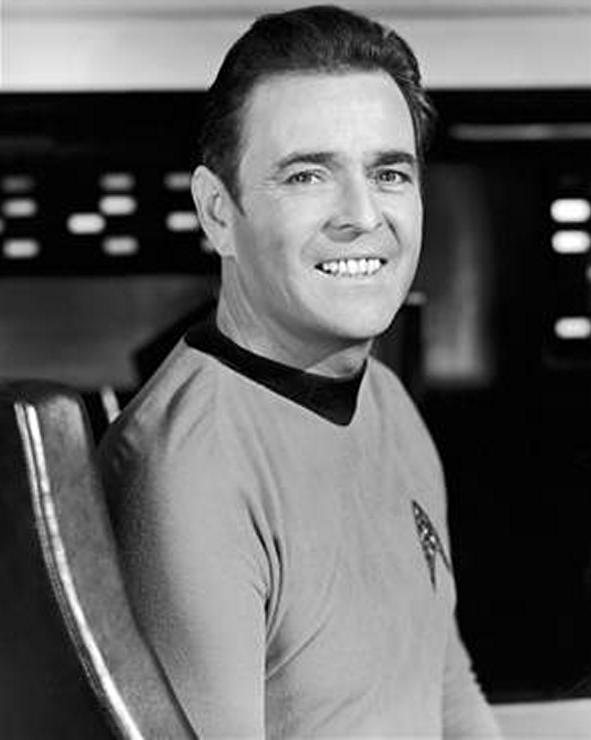
However, it did give an opportunity for many Canadian actors to perform in an international production which was shown in Britain, Australia and eventually syndicated on U.S. television. Gilles Pelletier was Corporal Jacques Gagnier, the francophone officer in charge of the detachment. (A novel approach at a time when Hollywood was still fixated on the happy-go-lucky rogue French Canadian.”) Don Francks played the clean-cut Constable Mitchell and there were countless roles for Murray Westgate, Frances Hyland, Douglas Rain, Lloyd Bochner, Eric House, Bruno Gerussi, William Needles, John Drainie, Cec Linder, Jack Creely, John Vernon, Tom Kneebone, Martin Lavut, Larry Zahab (Lawrence Dane) and James Doohan, who went on to Star Trek fame as “Scotty.” The RCMP also provided the opportunity for Canadian directors like Don Haldane, Paul Almond and Peter Carter to develop their talents, although Bernie Gerard, a Hollywood director, was put in charge of the first 13 episodes. Image left: James Doohan, who went on to Star Trek fame as “Scotty.”
The St. Lawrence North series (Au pays de Neuve-France) was produced simultaneously with The RCMP series. On January 12, 1959, the creator and scriptwriter, Pierre Perrault, left Ottawa with the director and editor Rene Bonniere, for one year of location shooting along the North Shore from Tadoussac to the Straits of Belle Isle. The subject of the 13 half-hour programs may seem a little recondite for a commercial company, considering that the Crawleys were already involved in a major TV series. However, the Crawleys had a keen interest in Quebec dating back to Ile d’Orleans and Canadian Power. The series is mainly of ethnographic interest today, but it had a profound effect on the subsequent films made by Perrault, in particular the film trilogy-Pour la suite du monde, Le Regne du jour and Les Voitures d’eau.
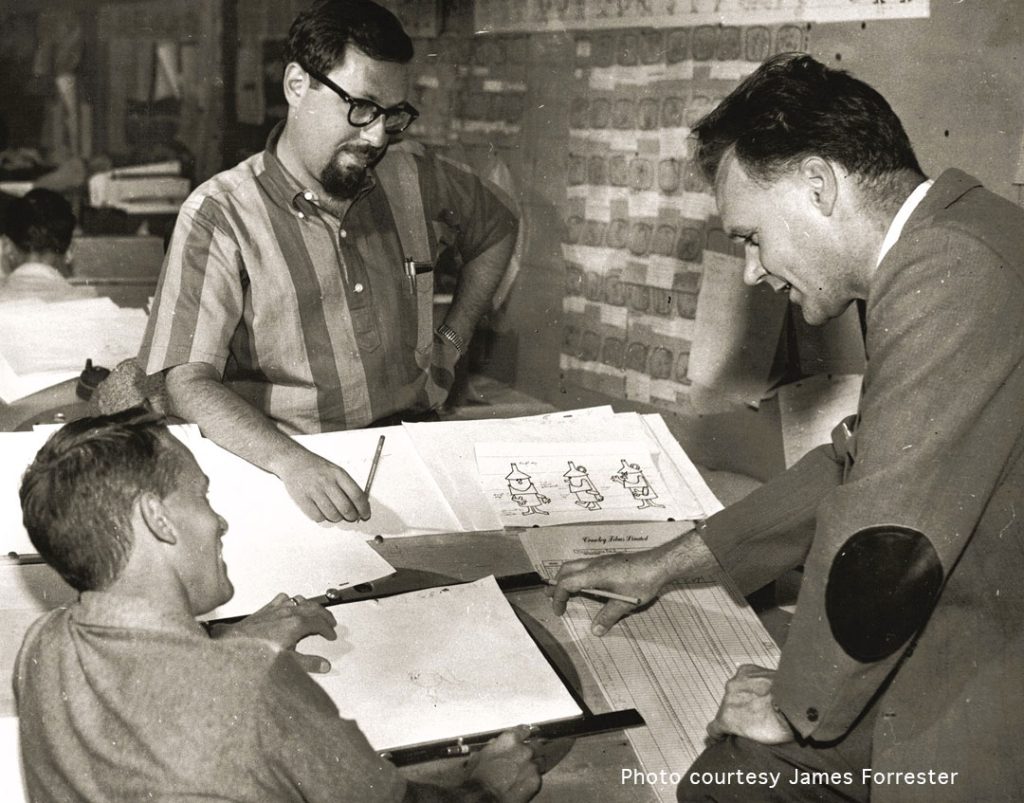
These two endeavours into television production encouraged Crawley to try his hand at animation. Crawley Films had made use of animation in many of their productions, right from the beginning. However, a contract to make 130 five-minute animation cartoons based on The Tales of the Wizard of Oz series for Videocraft of New York in 1962, required a large increase in specialized staff. The finished cartoons became a staple of Saturday mornings for years to come. The following year, a 51-minute final special Return to Oz was completed. It aired on February 9, 1964, on the G.E. Fantasy Hour. At that time, the Crawleys had 40 animators working full time including Bill Mason, Barrie Nelson, Rod Willis and Norman Drew. It was only the second animated feature ever made in Canada. Image left: Crawley Films animation department Bill Mason, Tony Peters, Tom Glynn, Wizard of Oz series 1962.
In 1962, Rene Bonniere convinced Budge to bankroll David Walker’s feature-length script entitled Staircases. The story concerned a mild-mannered man whose well-manicured lawn suddenly erupts in mushrooms. The point of the film had something to do with ecology, but was ahead of its time in voicing a concern about the environment. Released as Amanita Pestilens (Poisoned Love), it only found an audience once at the 1965 Berlin Film Festival, where it was sold to West German television and beamed into East Germany for rather obscure political reasons. Amanita Pestilens had a number of distinctions to its credit, including the first screen appearance of Genevieve Bujold, the first Canadian feature filmed in colour and the first feature shot simultaneously [in] both official languages.
In 1969, on its 30th anniversary, the company had completed 1,800 films, 600 TV commercials, 100 slide shows and garnered 180 national and international film awards. Crawley Films was the busiest commercial producer of educational and documentary films in North America—second in the world. This period was the pinnacle for the business side of the company.
Budge’s passion for features, which began with the success of The Luck of Ginger Coffey in 1964, continued through the 1970s. He was the producer of a television production of Hamlet (1971), The Rowdyman (1972) starring Gordon Pinsent, the Murray Markivitz feature August and July (1973), the rock documentary Janis (1974) and finally Heartland Reggae (1982). Crawley Films received their first Academy Award for a Canadian feature film, a documentary called The Man Who Skied Down Everest in 1976. Budge Crawley’s acceptance speech was memorable: “Thank you very much for this American award for a Canadian film about a Japanese adventurer who skied down a mountain in Nepal.”
The history of Crawley Films and Budge Crawley were inextricably wound up in each other until the sale of Crawley Films to Atkinson Film Arts on May 12, 1982. The majority of the films made by Crawley Films were deposited in the National Archives in 1984. Judith Crawley died in 1986, Budge in 1987, but the company they founded managed to survive to see its 50th anniversary in 1989, whereupon it went into bankruptcy.
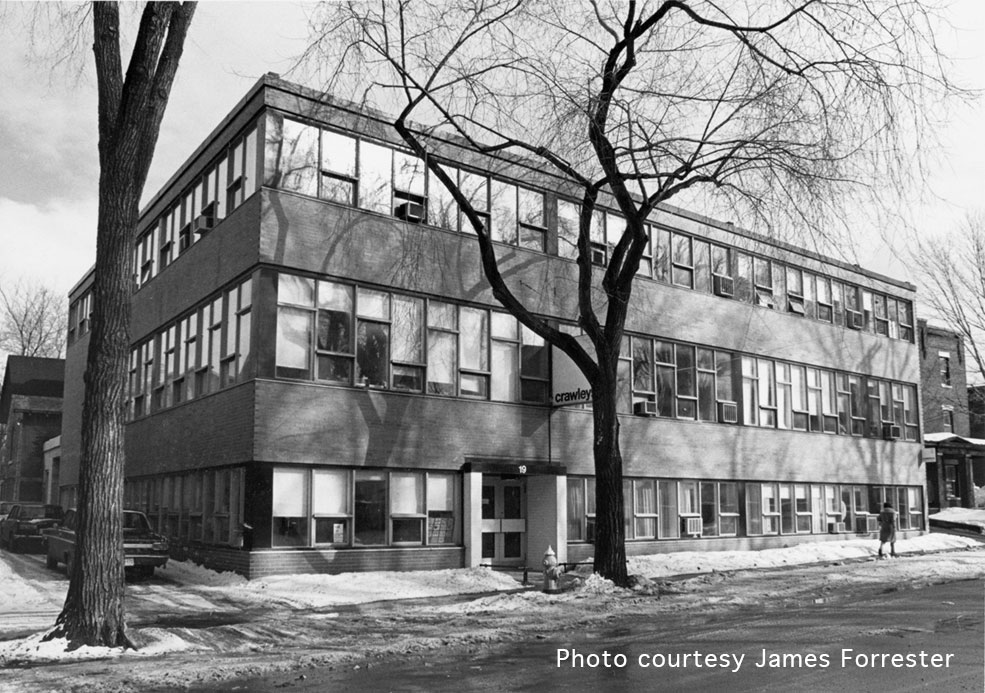
Budge Crawley’s tangible accomplishments have been recognized. Trent University presented him with an honorary degree in 1979 and he received an Order of Canada in 1980. However, the personal side of Crawley is little known beyond the informal alumni of “Crawley College,” as it became known in the industry. In the beginning, he could have taken the easy road and continued as an accountant in his father’s footsteps and he would have retired as a wealthy individual. Instead, he chose to strike out in a bold new direction, which he pursued throughout his lifetime. His instinct for the possibilities of film and television was unique and his career spanned the gulf between silent amateur films and pay TV, no mean feat in itself.
To say that Budge Crawley and Crawley Films have been ignored by Canadian film historians is an understatement. The Canadian Film Studies Association neglected to even mention Crawley in its 100th anniversary of film in Canada issue in 1996. [Although Take One did in its 100th anniversary issue. Ed’s note.]
Recent film scholarship (best exemplified in Joyce Nelson’s book The Colonized Eye: Rethinking the Grierson Legend) has re-examined assumptions about Grierson’s philosophy and his role in launching the NFB. Nelson “outed” Grierson by arguing that the left-wing populist legend is a myth, and she convincingly details his commitment to the expansion of multinational corporations. It would be truly ironic if a company like Crawley Films, which openly served the role of promoting a corporate agenda, was really Grierson’s ideal and not the NFB.
